

Why India’s rural water mission will be judged by what flows in year five, not the day of connection
By Qazi Syed Wamiq Ali
Every village that gets a tap tells a good story. A pipe is laid, a ceremony is held, and a household that once walked for water now turns a handle. Under the Jal Jeevan Mission, millions of rural households have been brought into this story in just a few years, and it is a genuine achievement.
But the real test of a water scheme comes later, on an ordinary Tuesday three years on, when the pump trips or the pipeline leaks. That is when the real question emerges: how will villagers get it fixed, and what will be their strategy? For rural India, that moment will decide whether the mission delivers water sustainability and security or merely a large inventory of taps.
The problem hiding behind the pipes
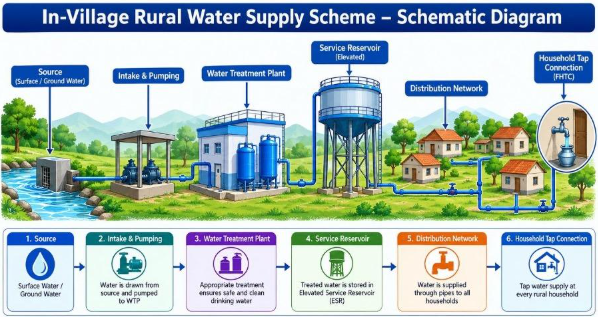
India has long been better at building water infrastructure than at running it. A scheme commissioned with fanfare is handed to a village committee, a Gram Panchayat or an under-resourced line department. The contractor leaves, and the engineers move on to the next project. What remains is an asset with no clear owner, no assured budget and no trained hands.
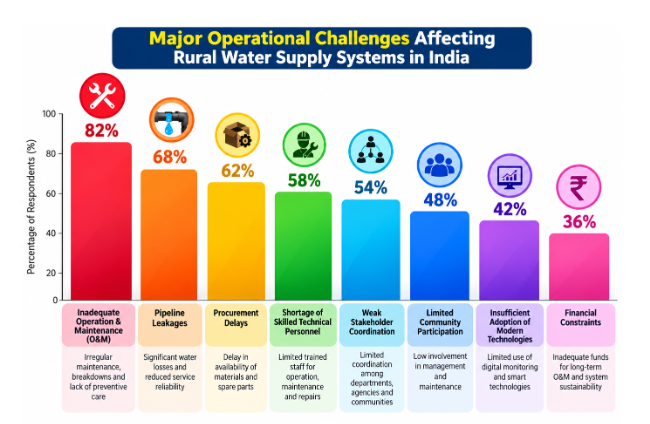
Our field study of rural water supply projects set out to understand what goes wrong at this stage. A total of 100 respondents were interviewed to assess the availability, accessibility and reliability of rural water supply and to identify the challenges involved in running these schemes. The findings reflect respondents’ perceptions rather than engineering audits, but they point to recurring operational concerns that should matter to policymakers.
Only about one in five respondents said maintenance in their schemes is carried out regularly. About half described it as irregular, and the rest said it happens only “sometimes”. Roughly 55 per cent named pipeline leakage and poor maintenance as the major problems. Nearly four in ten said spare parts are simply not available when needed, and another third said they are available only occasionally. A pump that sits idle for want of a part counts, for the household, as a failed scheme.
These are not exotic failures. They are the dull operational problems that sink public infrastructure everywhere: delayed procurement, thin inventories, slow repairs, weak monitoring and coordination that stalls between agencies. More than half of respondents named coordination among government, technical teams, contractors and communities as their biggest management challenge.
Communities cannot be the only safety net
For years, rural water policy has leaned on community management. The logic is sound. People who use a system have the most to gain from keeping it running. But our respondents suggest that the promise is far from realised: only about one in five described village communities as actively involved in managing their water supply.
The international evidence points the same way. Studies of community-managed systems repeatedly find that volunteer committees cannot sustain complex schemes alone. They need continuing technical backup, reliable finance and institutional support from the state. Handing a piped scheme to a village committee, with treatment units, pumps and a distribution network, and then expecting it to manage everything unaided is not empowerment. It is simply delegation without sufficient resources.
Technology is welcome, but it is not a substitute
Our survey also revealed a striking gap. About half of respondents said no modern monitoring technology is used in their schemes. Yet nine in ten agreed that such tools would improve efficiency. Sensors, flow meters, GIS mapping and remote dashboards can flag a failing pump or a leaking main long before a village complains.
But technology only works where someone is trained to act on the data. A sensor that reports a fault to a screen nobody watches is a poor investment. The sequence matters: clear responsibility, trained operators, stocked spares and funded maintenance first, then digital tools to make all of it faster and more transparent.
Five things worth doing now
Fund the recurring costs. Capital grants build schemes, but electricity, repairs, chemicals and operator pay keep them running. Every scheme needs a transparent, predictable O&M budget, supported by realistic and fair cost recovery, before it is commissioned, not after it breaks.
Make accountability unambiguous. Each scheme should have a named responsible body, a service standard and a way for users to report faults and see them resolved.
Invest in people. Rural operators, village committees and block-level engineers need regular training, clear procedures and career pathways. Skills built once and never refreshed fade quickly.
Stock the shelves. Decentralised inventories of essential spares, with better procurement planning, can turn week-long outages into same-day repairs.
Measure what matters. Success should be tracked by whether water flows reliably and safely over time, not by connections made. Functionality, hours of supply, repair times and water-quality compliance should be public.
A mission measured by its second decade
India has proved it can build at scale. The harder task is to sustain what it builds, through the unglamorous work of maintenance, spare parts, trained staff, steady money and coordination. A tap that runs dry in year three erodes trust in the next scheme and the one after that.
The mission’s ambition was never just to lay pipes. It was to deliver water, reliably, to every rural household, for the long term. That promise will be kept or broken in the operations room, the repair shed and the village committee meeting, long after the inauguration plaque has been unveiled.