

Kurita Water Industries Ltd. (Head office: Nakano-ku, Tokyo; President: Hirohiko Ejiri; hereinafter “Kurita”) has added new features to its original predictive diagnostic service (hereinafter the “Service”) which provides predictions of quality degradation, operational issues, and water quality fluctuations in the manufacturing process. The new function automatically proposes appropriate measures and improvement actions for operators, in addition to its existing functions that support prediction and analysis of contributing factors. This new feature provides end-to-end support, from predicting operational issues and analyzing contributing factors to considering and implementing countermeasures.
In the manufacturing industry, challenges include knowledge transfer due to the retirement of skilled workers and labor shortages caused by a declining working population. Moreover, it is necessary to improve product quality and production efficiency and enhance competitiveness with those limited workforce. In order to support these customer challenges, Kurita began the full-scale rollout of the Service for the paper product manufacturing process in paper mills in September 2024. Based on the predictive diagnostic technology developed through its application in the paper industry, we are expanding the scope of application to address the challenges and meet the needs of customers’ manufacturing and water treatment sites. The Service has since expanded to other industries and processes, such as steel manufacturing and wastewater treatment processes.
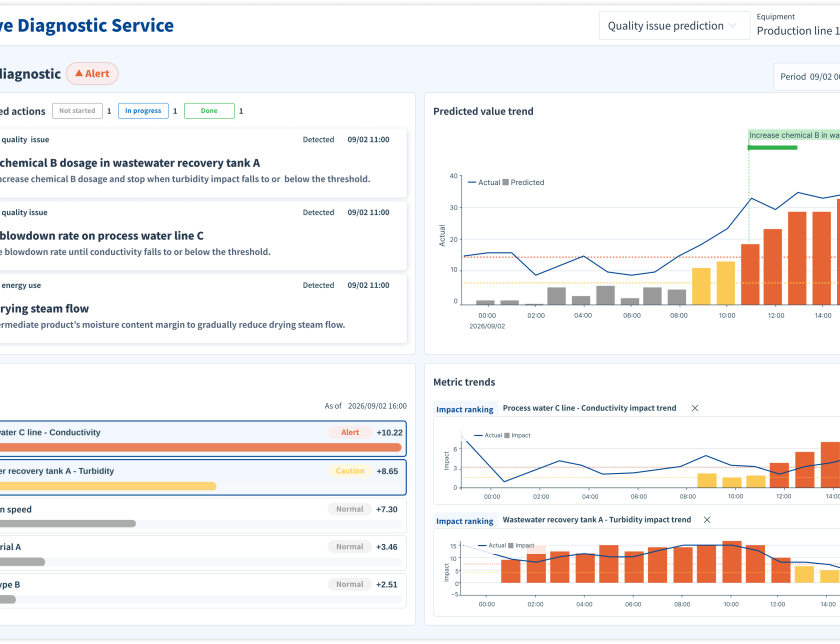
The Service visualizes various process data, including water quality data collected through Kurita’s water treatment management service “S.sensing™” series and operational data from manufacturing and water treatment processes, and leverages its proprietary predictive models to predict quality deterioration, operational issues, and future water quality conditions, while automatically analyzing contributing factors and performing simulations. These capabilities support the consideration of preventive measures and the quantitative assessment of their effectiveness in plant operations. On the other hand, operational sites bear a burden that they have to consider and decide on appropriate preventive measures based on the results of the predictions and analysis.
The newly added features automatically suggest specific recommended actions, such as “what to check and what actions to take,” to prevent troubles and improve operations by registering the knowledge that Kurita and customers accumulated as “recommended measures” and comparing them with the analysis results as judgment logic. Furthermore, the new features continuously support on-site personnel by reviewing and refining recommended measures and decision logic using accumulated operational data, such as the records of response date and time, the measures taken, and their results. As a result, it helps shorten the time required to identify, decide on, and implement countermeasures when signs of water quality degradation or operational issues are detected, while helping stabilize operations by reducing variations in decision-making among personnel and improving operational efficiency and labor saving through the recommendation of improvement measures.
Kurita will introduce the new features with the Service at the 69th Japan Technical Association of the Pulp and Paper Industry Annual Conference (Chiba Makuhari), to be held from October 27 to 29, 2026.
The Kurita Group will contribute to the realization of a sustainable society by creating and providing solutions that reduce running costs and labor, save water, reduce GHG emissions, and contribute to resource circulation through the active use of digital technology.