
Namisha, Junior Research Fellow, Alumna of Banaras Hindu University
The famous line “water, water everywhere, nor any drop to drink “ from the work of Samuel Taylor Coleridge beautifully captures the essence of the water crisis that the contemporary world is currently facing. The line captures the paradox of having an abundance of resources with the simultaneous existence of scarcity. As per world bank, 2 billion people worldwide lack safe drinking water, while 4 billion experience severe water scarcity for at least one month each year. The report of the World Bank Group projects a 40% global shortfall between water supply and demand by 2030. However, since childhood we are taught the abundance of water on earth surface covering almost 71% of earth and even if only a fraction of this water is readily available for direct consumption, the innovation in science and technology through which water is made available to even deserts the existence of severe water crisis is a fact difficult enough to digest. However, a closer look will bring forth the hidden dimensions of the water crisis. The data on global and domestic wastage shows that almost 30% of all treated and piped water worldwide is lost or wasted, equalling roughly 9.5 trillion litres. Hence, the issue is not just about scarcity of water but also the problem of water being lost evenbefore it reaches the consumer. This loss can be both in the form of physical loss via poor piping or illegal connections and unbilled consumption. This gives rise to the problem of Non Revenue water ( NRW), in simple terms , it means water that has been produced but couldn’t generate revenue for the entities involved in its supply or distribution also known as water utility.
The multifaceted nature of water loss.
The loss of water is a multidimensional problem encompassing both physical loss due to poor infrastructure in the form of leaks in pipes or commercial loss due to faulty meters and non-billing.
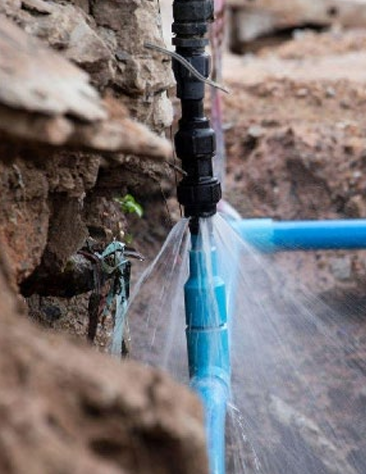
The dimensions are explained briefly to capture the extent of the problem at hand. Physical loss: This is the most visible form of water loss. This happens mainly because of the poor state of infrastructure in the form of leaking pipes, overflowing reservoirs, faulty valves, or broken pipes. This is the actual loss of water from the distribution network, because of which the resource gets wastage.
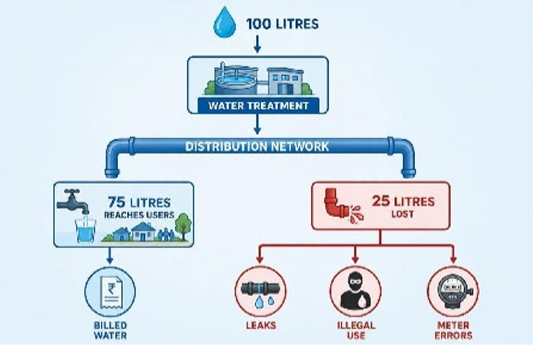
Commercial loss: This is suffered by utilities as water is being consumed without being properly accounted for. This includes inaccuracies in the meters, illegal connections, errors in billing, and tampering with meters. This highlights that it’s not just physical loss of resources, but sometimes it reaches the consumer for consumption without generating revenue for utilities. This is Non-Revenue Water, and the World Bank defines it as water that is produced and lost before reaching the consumers, generating little to no financial return for the utility. In the simplest way, suppose 100 litres enter a City network, out of which 75 litres reach consumers and are properly billed, but the remaining 25 litres are lost or are unaccounted for.
Unbilled authorized consumption is another issue which calls for immediate attention. This refers to water that is legally and intentionally used within the distribution network but generates zero revenue for the utility. This includes free water to government facilities, public parks or community drinking troughs. This creates several problems, for example if utilities cannot account for large volume of water loss, the managers can hide the True extent of underground leaks, delaying major repairing works.
Examples from around the world to address and understand the issue
Phnom phnh model: from massive loss to model utilities: The role of institutional reforms in cutting down water loss is excellently shown by the Phnom Penh Water Supply Authority ( PPWSA) in Cambodia.. At a certain point,phonm penh had extremely high rate of water loss. The World Bank reports that (PPWSA) reduced non, technical losses from over 70,% to less than 6% by 2007. However, what was worth noting is that they didn’t just replace pipes but solved the problem through a multi staked approach including improved Customer records, widespread coverage of metres, improved billing mechanism, better management of distribution networks, incentives for staff, investments in infrastructure along with financial reforms in the form of tariffs. The efforts were rewarded by 2000 when the authorities achieved 100% metering, while providing the poor households with subsidies and reduced tariffs. The story highlights the fundamental aspect of the problem. Its not always the pipeline which needs fixing but rather a systematic reform in different sectors and a multipronged approach to solve the problem.
Singapore model – check the leakage before it leaks
Singapore model Focuses on proactive management of infrastructure in order to prevent any kind of future loss or if that does happen then to reduce the gravity of the problem. As per the reports Singapore’s National water agency PUB manages a portable water pipeline network of around 6000 kilometre serving 1.7 million households and businesses in 2024 PUB repaired 267 pipe leaks equivalent to approximately 4.5 leaks per 100 km of water pipes compared with 5.7 per 100 km 2014. Theirs approach is quite easy to understand as instead of waiting for the pipes to break and then expecting people to complaint and then the government will act upon it ,in the Singapore the focuses on monitoring the infrastructure detecting any kind of deterioration or leakage and then replacing or maintaining it to prevent any kind of Major loss since, the cheapest leak is the one you prevent.
India the challenge of addressing the problem of water loss in cities.
Amrut 2.0 ( Atal Mission for rejuvenation and urban transformation 2.0),a flagship programme of government of India launched in 2021,aims to make Indian cities self reliant and water secure. Its Pey Jal Survekshan framework identifies reducing NRW to below 20% as a major reform agenda and requires Urban local bodies to provide information of water produce and consumed supported by regular water audits. The importance of such planned mechanism is seen in the form of Rapid urbanization which creates pressure on limited resource, poor infrastructure in the form of ageing pipelines, illegal connections or connection with tempered meters all contributing to high losses pushing for exploring new sources of water while losing the one we already have. The World Bank further notes that proper management can sometimes be more cost effective than simply expanding water supply in water constrained environments. Thus such planned time bound goals as highlighted by AMRUT 2.0 can prove to be a instrumental factor in reducing the wastage.
The interplay of policy framework, regulations and financial investment
To address the above-mentioned problems we need a wholesome approach not isolated fixes. The case studies from around the world as discussed can help in developing a holistic approach to tackle the problem of water loss whether in physical form or in the form of Non Revenue Water ( NRW). This involves an approach which includes proper policy frameworks, proper regulations not complying with which should invite proper consequences and wherever require providing financial incentives or investments. In the subsequent paragraphs will try to look into each approach to have a proper understanding of all the approaches, combination of which can bear fruits in the direction of reducing water loss.
Policy framework : This involves deciding what matters the most. Certain policy programme can bring significant changes in the process of reducing water wastage. This involves setting measurable targets for NRW, for example instead of saying we need to reduce NRW, the focus should be on having x % of reduction from y% in the next 5 years. This provides the water utility with concrete goals and some motivation to work efficiently.
Second can be mandatory water audits. This is linked to making the water utility accountable for the loss. They should have the data regarding how much water was produced, how much is distributed, how much is consumed & finally the amount of water that was lost.
The practice of District Metered Areas is prevalent in many cities, which is also a way to keep a better track of the amount of water loss. This involves dividing larger cities into smaller zones, making it easier for authorities to identify where losses are concentrated. Last but not least, digital monitoring via Smart meters, sensors, GIS ( geographic information systems), and digital billing can all help.
Regulatory framework: It is important to note that a mere policy framework was never, and will never be, what we require is a proper regulatory framework to make water utilities accountable. It is the system of laws, rules, standards, monitoring mechanisms, and penalties to control how an activity is being carried. This can be done in the form of putting the onus of accountability on water utilities in the form regulations which require them to properly measure NRW, publish performance data, means knowing the exact developments in the field of water loss, maintaining infrastructure, mandatory repairing of leaks within a time bound manner, installation of accurate meters starting from treatment plants, to major distribution points, commercial premises and finally to the level of households, preventing illegal connections and meeting all the efficiency standards and comply by it. The point here is that, since water utilities are responsible for supplying water it should be responsible for the Water it looses.
Another point which is worth noting is setting a maximum acceptable level of water loss, and failing to do so should invite necessary consequences. As mentioned earlier, AMRUT 2.0 tries to do this in the form of its policy of reducing non-revenue water (NRW) below 20% as part of its reform agenda.
Financial approach to reduce water loss: This is a very straightforward approach; we cannot repair a 75-year-old damaged pipe with mere good intentions; it needs money. The losses can occur because of aging pipelines, broken valves, leaking reservoirs, inadequate meters, poorly maintained pumps, or an outdated distribution system. These problems can be tackled via municipal budgets, government grants, Development Bank loans, or infrastructure.
Performance based financing, is also good way to start with. Under this funding or payment is directly linked to concrete results. In short, it highlights the point that investing money is not enough instead it focuses on whether it brought tangible benefits or not.
Water tariffs, which raises eyebrows has its own pros and cons. This is mainly because any kind of infrastructural projects like water treatment plant ,electricity generation ,pumping, maintenance of pipelines, meter installation ,staffing, repairing everything requires money to finance this. One way to generate revenue is via taxes. However It’s a tricky suggestion as just increasing the cost of water is not the solution as it can make weaker sections more vulnerable to have even the basic requirements of existence , thus we have to have a judicious approach while considering taxes. There should be a proper balance between financial sustainability while maintaining the need for social protection for the downtrodden sections of the society as we cannot and mustn’t have One size fits all approach . However the provision of proper and well planned taxes can prove to be a encouraging factor in maintaining and repairing all the poor infrastructures as due to dearth of enough revenue mainly because water utilities suffer from NRW, they find it difficult to maintain pipelines , detect leaks or replace poor meters, or making upgrades in the infrastructure etc. But, enough articulations should be prioritised in order to create a level playing field in access to water for both well off and poorest sections of the society in the form of subsidies etc.
Stop searching, start saving
As per reports Non Revenue Water in India stands at 31%, which is a major trouble for distribution networks thus calling for immediate attention by policy makers. The importance of reducing the percentage is highlighted in the set target by Ministry of housing and urban affairs, under the flagship programme of government of India named AMRUT 2.0 to below 20%. IMF’s 2025 working paper estimates that roughly 36% of water produce is lost as non revenue water on average while two third of country’s reports NRW above 30%. This highlights that water security is not always about finding new sources to increase supply but rather the ability to save what we already have. Various examples from different countries have shown us the pathways of attaining efficient resource management . The need of hour is not policy twitching or putting more stringent regulations or pumping more money in the system but rather it’s the interplay of all the approaches working in a tandem to fetch better results in the direction. The race for finding newer sources of resource will take us nowhere as this will only increase the supply without making any fundamental changes in the efficient management of already available resources. Hence, the focus should be on saving more instead of searching for more.