
By Shreyansh Shah, Director, at LEXCRU Water Tech Pvt. Ltd
Sanalkumar, Associate Vice President, at LEXCRU Water Tech Pvt. Ltd
Zuo Jian, Co-founder, at SideStroem Water Technologies Pte. Ltd
The growing need for ZLD Access to clean water is no longer a certainty—it’s an emerging fault line of global stability. In 2024, São Paulo narrowly avoided a second major “Day Zero” as drought once again pushed its reservoirs to historic lows. Kenya is facing its worst water crisis in 40 years, affecting millions with a lack of clean water and food while northern China continues to battle shrinking groundwater tables that threaten entire agricultural regions. Across the globe, the American Southwest, southern Europe, and parts of Southeast Asia are facing the same reality: water scarcity is becoming a structural, not cyclical, risk.
These events illustrate a fundamental truth—the economics of inaction no longer add up. When water insecurity disrupts industries, energy systems, and public health, the cost of enforcing stronger recycling and treatment standards quickly outweighs the price of doing nothing. With industry consuming roughly 20% of global freshwater—and generally having the technical and financial means to act—governments are tightening limits on industrial wastewater discharge. Beyond conserving scarce freshwater, these measures also protect aquatic ecosystems and safeguard communities downstream. At the highest level of wastewater management sits Zero Liquid Discharge (ZLD) — a process that eliminates all liquid waste leaving industrial facilities. Although ZLD offers complete environmental protection, it is also the most capital- and energy intensive option.
The cost challenge of conventional ZLD
Traditional ZLD systems rely heavily on thermal evaporation technologies such as multistage evaporative distillation (MED), multistage flash distillation (MSF), crystallizers, and evaporation ponds. While effective, these systems have several major drawbacks:
- High energy consumption due to dependence on heat or electricity.
- High capital cost for corrosion-resistant construction materials.
- Large land requirements for evaporation ponds.
- Low evaporation efficiency, leading to high operational costs.
These limitations have driven strong interest in membrane based technologies that offer lower energy use, better corrosion resistance, and more compact designs. Emerging solutions include osmotically assisted reverse osmosis (OARO), membrane distillation (MD), electrodialysis (ED), and forward osmosis (FO).
SideStroem’s approach: Nano-Selective Forward Osmosis (Fons)
SideStroem Water Technologies Pte. Ltd. based in Singapore, focuses on developing efficient, selective, and sustainable technologies for resource recovery from industrial wastewater and optimization of industrial processes. Our proprietary nano selective forward osmosis (FOns) technology is designed to enhance water and salt recovery while reducing energy consumption in ZLD processes by up to 55%.
SideStroem’s FOns technology offers several advantages over conventional FO and pressure-driven membranes:
- Operates without external pressure, minimizing energy use.
- Low fouling tendency and suitable for heat- or pressure sensitive feeds.
- Selective recovery of both water and valuable salts, rather than rejecting all solutes.
- Enables simplification of ZLD systems by potentially eliminating energy-intensive evaporator units.
In traditional ZLD systems, tertiary treatment (typically evaporation and crystallization) accounts for most of the energy and cost burden. Replacing these units with FOns membranes can achieve CAPEX and OPEX savings exceeding 50%, while improving sustainability and scalability.
The FOns membrane concept
Conventional FO membranes are designed mainly for water extraction, using reverse osmosis-type (RO-type) rejection layers. These membranes achieve high solute rejection but suffer from low water flux and poor ion selectivity. Nanofiltration (NF) membranes, on the other hand, allow selective ion transport but are not well-suited for FO operation due to high internal concentration polarization (ICP) and compact support structures.
SideStroem has bridged these gaps by combining the strengths of FO and NF membranes into a single, nano-selective FO platform.
The resulting FOns membrane offers:
- High water permeability
- Selective ion separation
- Low fouling and high operational stability
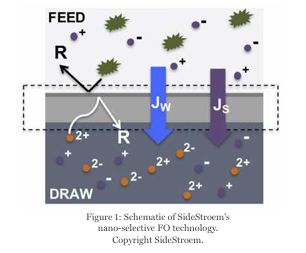
This enables efficient and simultaneous recovery of water and valuable salts from industrial effluents — improving resource recovery and significantly lowering operating costs in ZLD systems.
Our beachhead market is India’s textile industry where Zero Liquid Discharge (ZLD) has become the gold standard in wastewater treatment. Recognizing the sector’s need for water and stringent regulatory environment, SideStroem aims to demonstrate how nano-selective forward osmosis (FOns) can deliver both environmental and cost advantages in dye removal and resource recovery.
Beyond textile effluent treatment, FOns technology offers broad applicability across multiple sectors that require efficient separation, concentration, or recovery of water and solutes.
Potential application areas include:
- Dye concentration and desalting during dye manufacturing with reduced fouling and extended membrane lifetime compared to traditional nanofiltration processes.
- Food and beverage processing, for gentle concentration of liquids without thermal degradation.
- Pharmaceutical product concentration, where maintaining bioactivity and purity is essential.
- Fermentation enhancement, where controlled removal of inhibitory by-products can increase yield and enable continuous processing.
These applications demonstrate the versatility of FOns membranes in addressing diverse industrial challenges beyond wastewater treatment.
Pilot demonstration for separation of dye from industrial effluent by Fons
SideStroem, in collaboration with LEXCRU Water Tech Pvt. Ltd.,
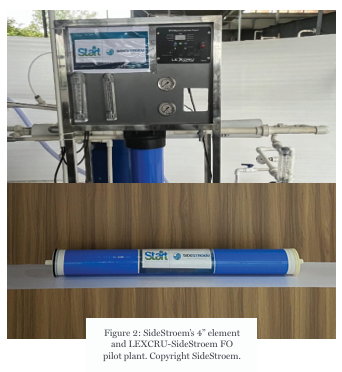
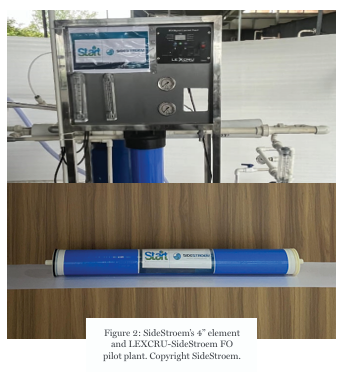
successfuly completed the first on-site pilot testing of our 4” (4040) nano-selective forward osmosis technology. The purpose of this pilot was to evaluate the feasibility and performance of FO for removing dyes from industrial effluents under real operating conditions. Figure 2 ilustrates the 4’’ element and the LEXCRU–SideStroem FO pilot plant.
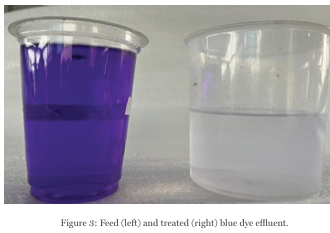
In this demonstration, a model dye wastewater was prepared using blue dye at a concentration of 400 ppm, while the draw solution was 0.5 M MgSO4. The feed water was circulated through the shel side of the FO membrane element at a pressure of 2 bar and ambient temperature (27 oC). The draw solution was pumped on the permeate side at a pressure of 0.5 bar. To enhance sustainability, the draw solution was recovered using NF membranes and recycled within the system. An expected FO water flux of 10 LMH was achieved under these pilot operating conditions. Figure 3 shows the comparison of the feed wastewater and treated effluent. The treated effluent appeared clear and colourless, confirming the effective removal of blue dye by the FO membrane. Analytical measurements conducted using UV VIS spectroscopy indicated a 99.5 % dye rejection, demonstrating the strong separation performance of the FOns technology.
What’s next?
Folowing the successful pilot demonstration, SideStroem and LEXCRU are now exploring a Joint Venture (JV) in India to support manufacturing and commercialization SideStroem’s FOns technology. This partnership aims to localize production, accelerate market deployment, and enhance competitiveness for large-scale implementations.