
Anoop V Kartha, Head – Special Initiatives, VA TECH WABAG LIMITED
Introduction
As nations commit to aggressive decarbonization, the demand for sustainable, renewable fuels has reached an all-time high. In India, a transformative solution is emerging from an unlikely source: municipal sewage. Traditionally viewed as a sanitation burden & a source of environmental pollution, sewage is now being redefined as a strategic energy asset. By capturing methane from wastewater treatment & upgrading it into Bio-CNG (Compressed Biogas), cities can address waste management, reduce greenhouse gas emissions & bolster national energy security simultaneously.
The Current Situation: India’s STP Landscape
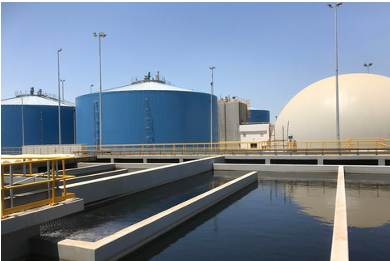
India’s urban centers are currently grappling with a massive waste crisis, generating over 72,000 million liters per day (MLD) of municipal sewage as of 2025, yet a staggering gap remains as only about 28% of this volume undergoes functional treatment. This deficiency leads to severe environmental consequences, including the eutrophication of water bodies & the uncontrolled release of methane, a potent greenhouse gas that exacerbates climate change. Despite the expansion of infrastructure under the Swachh Bharat Mission 2.0 and AMRUT 2.0, most existing Sewage Treatment Plants (STPs) operate merely as basic pollution control facilities, lacking the dedicated anaerobic digesters & biogas capture systems necessary to unlock the significant energy potential currently left untapped within the waste stream.
Bio-CNG: The High-Value Energy Vector
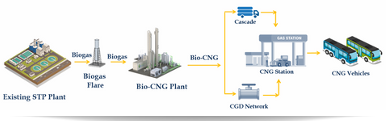
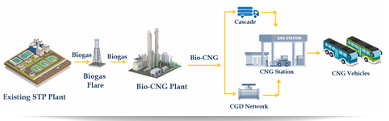
Bio-CNG represents a high-value energy vector, consisting of a purified form of biogas with a methane content of 92–98% that renders it nearly identical to conventional fossil-derived CNG. The conversion process involves taking raw biogas produced through anaerobic digestion and subjecting it to advanced cleaning and upgrading—specifically removing moisture, hydrogen sulfide (H2S) and carbon dioxide (CO2)—before compressing it for use in vehicles or industrial grids. Unlike direct electricity generation, Bio-CNG offers a more versatile and commercially valuable output, delivering significant sustainability benefits by displacing fossil fuels and enhancing national energy security by reducing dependency on imported LNG, which is projected to meet 45% of India’s demand by FY26. Furthermore, this technology facilitates revenue generation by transforming Sewage Treatment Plants (STPs) from traditional “cost centers” into “profit centers” that produce a steady stream of high-demand fuel, all while offering the scalability for modern modular upgrading systems to retrofit existing infrastructure into thriving renewable energy hubs.
Engineering the Transformation: The WABAG Model
With over a century of expertise, VA Tech WABAG is leading a paradigm shift from basic wastewater treatment to holistic resource recovery through a sophisticated “Waste-to-Wealth” cycle. This solution begins with an optimized anaerobic digester design specifically tailored to India’s diverse sewage characteristics to maximize methane yield and biogas recovery. To ensure this biogas meets stringent vehicle-grade standards, the company utilizes state-of-the-art purification and upgrading systems for high-purity conversion. WABAG’s unique retrofitting expertise allows for the modernization of existing STPs with minimal disruption to ongoing operations, while its robust Operation & Maintenance (O&M) protocols leverage data-driven insights to guarantee consistent gas yields and minimal downtime. By engineering facilities to international benchmarks that are specifically adapted to local feedstock and conditions, WABAG successfully executes complex urban projects through proven Design-Build-Operate (DBO) and Public-Private Partnership (PPP) models, ensuring long-term sustainability and performance.
WABAG has initiated its first demonstration project for converting sewage derived biogas into Compressed Bio Gas (CBG), marking a milestone in sustainable urban infrastructure. The project—executed in PPP mode with Ghaziabad Nagar Nigam (GNN)—is being developed at the 70 MLD Dundahera Sewage Treatment Plant. Once operational, the facility will generate 1.8 tonnes per day of CBG, which will be supplied to Oil Marketing Companies, contributing to India’s clean energy transition. As part of the agreement, WABAG will procure raw biogas from the GNN-operated STP and take complete responsibility for the investment, design, engineering, installation, and 15-year O&M of the CBG plant.
Proven Success: Key Projects
VA Tech WABAG has already demonstrated the tangible viability of biogas to-energy models through successful implementations across major Indian metros. In Varanasi, the 140 MLD JICA-funded project at Dinapur utilizes an activated sludge process coupled with biogas-based power generation to move the facility toward complete energy neutrality under the Ganga Action Plan. Similarly, the Rithala plant in New Delhi serves as a landmark waste-to energy initiative for the Delhi Jal Board, effectively using biogas to slash reliance on the external power grid. Furthermore, the 110 MLD flagship plant at Kodungaiyur, Chennai, showcases the pinnacle of this technology, employing a 1 MW gas engine fueled by sludge-derived biogas to achieve an impressive 98% self-sufficiency in energy.
Policy Recommendations
To accelerate the adoption of sewage-to-Bio-CNG solutions, a strong and enabling policy framework is essential. Regulatory mandates should require the installation of anaerobic digestion and efficient biogas recovery systems at all sewage treatment plants with capacities of 20 MLD and above, supported by clearly defined technical standards for Bio-CNG upgrading and compression. Financial incentives such as capital subsidies, tax benefits, and access to carbon credit mechanisms can significantly improve project viability and investor confidence. Market development measures should focus on strengthening assured offtake under the SATAT scheme, introducing Bio CNG blending or usage mandates in urban transport fleets, and encouraging municipalities to adopt Bio-CNG-powered vehicles. Equally important is infrastructure integration through systematic retrofitting of existing STPs with digesters and upgrading systems, along with their integration into smart city energy hubs and city gas distribution (CGD) networks. Capacity building must be prioritised through targeted training programmes for plant operators and municipal engineers, public awareness campaigns to build acceptance, and structured knowledge-sharing platforms to disseminate best practices. Finally, industry collaboration should be encouraged by promoting CBG compatible vehicle offerings from automobile manufacturers, expanding public–private partnership models that leverage private sector expertise, and supporting research and development in advanced digestion and biogas purification technologies to continuously enhance efficiency and performance.
Conclusion: The Triple Dividend
The transition to a sewage-to-Bio-CNG model delivers a powerful triple dividend for Indian cities by ensuring cleaner water bodies through efficient and scientific wastewater treatment, producing cleaner energy by displacing fossil fuels with renewable Bio-CNG, and creating resilient urban infrastructure that is economically self-sustaining over the long term. When supported by enabling policy frameworks such as the SATAT (Sustainable Alternative Towards Affordable Transportation) scheme and combined with strong technical and execution expertise, this approach allows India to transform an unavoidable urban by-product into a strategic energy resource— contributing meaningfully to national decarbonisation efforts, strengthening energy security, and advancing the country’s Net Zero 2070 ambitions.