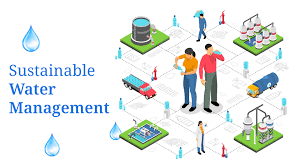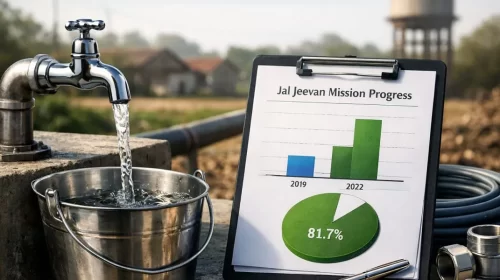

Union Budget 2026 marks a decisive shift in how India approaches water security while treating water not as a welfare obligation, but as strategic national infrastructure. The enhanced allocation of ~₹67,000 crore for the Jal Jeevan Mission directly addresses the funding shortfalls and delivery gaps of recent past years, where underspending constrained last-mile execution. At a time of growing groundwater stress, quality challenges, and climate volatility, this scale-up is both timely and necessary. Importantly, the Budget signals a move beyond connection-led metrics toward sustained service delivery, reliability, and water quality,…
Read MoreAuthor: eawater
Quote From Manish Jain, Managing Director, Enviro Infra Engineers Limited
“India’s Union Budget 2026 reinforces the government’s continued commitment to infrastructure led growth, sustainability and environmental resilience. The substantial increase in public capital expenditure to a record ₹12.2 lakh crore underlines a strong push for modern and integrated infrastructure development across transport, logistics, urban and water systems — a priority that directly expands opportunities in water, wastewater, sanitation and environmental engineering. The emphasis on creating new national waterways, enhancing multimodal logistics, and strengthening urban infrastructure aligns closely with our strategic focus on delivering advanced and scalable environmental solutions. This policy environment also…
Read MoreQuote from Pradeep Kanthed, Ceo, Tatanagar Metal Industries
The Union Budget 2026-27, presented by Finance Minister Nirmala Sitharaman on January 31, 2026, emphasizes three “kartavyas”: accelerating economic growth, fulfilling aspirations, and ensuring inclusive development under Viksit Bharat. It targets a fiscal deficit of 4.3% of GDP, down from 4.4% in FY 26 RE, with total expenditure at ₹35.3 lakh crore, prioritizing capex at ₹17.1 lakh crore. Fiscal Strategy The budget maintains fiscal prudence amid global uncertainties, aiming for a debt-to-GDP ratio of 50±1% by FY 31. Revenue receipts are projected at ₹18.1 lakh crore, driven by robust tax…
Read MoreUnion Budget 2026–27 in eyes of Technologists : A Systems-Level Blueprint for Growth
Dr Mayur J. Kapadia Former AGM, Quality Control Dept, GNFC Ltd, Bharuch, Gujarat TC Member & Resource Person, Bureau of Indian Standards Trainer & Technical Writer ‘Elsevier’ Author. Union Budget 2026–27 is the first budget prepared at the newly established Kartavya Bhavan. Structured around 3 core Kartavyas, it is a systems-level design document for the country’s next growth phase. While presenting it on 1st Feb, 2026, the FM defined 3 Kartavyas as (i) accelerating and sustaining economic growth, (ii) fulfilling aspirations through capacity building, and (iii) ensuring inclusive development…
Read MoreQuote from Jitender Thirwani, Chief Operating Officer Smarter Homes Technologies Pvt Ltd
The Union Budget 2026 comes at a time when India’s water challenges are no longer seasonal or regional—they are structural. With climate variability intensifying, urban demand rising, and groundwater levels declining, the conversation around water must move beyond supply creation to long-term resilience and accountability. One of the encouraging aspects of this year’s budget is the continued emphasis on water security, sustainability, and infrastructure strengthening. However, the real impact of these allocations will depend on how effectively water is measured, monitored, and managed at the point of consumption—especially in urban…
Read MoreQuote from Niranjan Nayak, MD, Delta Electronics India
What stands out in the Union Budget 2026 is the scale, consistency, and seriousness with which the government is approaching electronics and advanced manufacturing. The launch of India Semiconductor Mission 2.0 with an outlay of ₹40,000 crore, along with the expansion of the electronics components manufacturing scheme to a similar level, clearly signals a long-term commitment to building strong domestic capabilities. Importantly, the focus goes beyond manufacturing capacity to include full-stack design, development of Indian intellectual property, skill creation, and stronger supply-chain resilience. This reflects a practical understanding of how…
Read MoreQuote from Benjamin Lin, President, Delta Electronics India
This Budget brings together multiple strands of India’s manufacturing and technology growth story in a balanced and forward-looking manner. The ₹40,000 crore allocation for India Semiconductor Mission 2.0 and the enhanced outlay for electronics components manufacturing point to a clear focus on scale, depth, and ecosystem development. When seen alongside targeted support for MSMEs through a ₹10,000 crore growth fund, the policy framework addresses both large-scale manufacturing and the strength of the supplier base. By aligning capital support with capability building and innovation, the Budget creates a solid foundation for…
Read MoreQuote from Dr. Sanjeev Srivastava, Head of Industrial Automation, Delta Electronics India
What this Budget makes very clear is that the focus is no longer only on adding capacity, but on improving how manufacturing actually performs on the ground. Initiatives like the Semiconductor Mission and the plan to rejuvenate 200 legacy industrial clusters show a clear intent to raise quality, precision, and reliability across factories. The proposed ₹10,000 crore MSME growth fund is also an important step, as stronger and more capable MSMEs directly strengthen the manufacturing ecosystem as a whole. As manufacturing becomes more complex and technology-intensive, automation and digital systems…
Read MoreQuote from Neeraj Akhoury Managing Director, Shree Cement Limited
The Union Budget’s strong focus on infrastructure and balanced regional growth is encouraging. The proposed Infrastructure Risk Guarantee Fund will boost lender confidence and help attract private investment. Increased allocations for high speed rail, Tier II and Tier III cities, and temple towns will drive sustained demand across the construction sector. The support for CCUS is timely and reinforces the importance of clean technologies in decarbonizing hard to abate industries.
Read MoreQuote from Rahul Munjul, CMD, Hero Future Energies
(Download picture from this link: https://share.google/jusjZf3kQDu1CRC2I) I would like to congratulate the Hon’ble Finance Minister for rolling out a pragmatic yet visionary Union Budget, aimed at building a developed and self-reliant India. It sets a roadmap for inclusive, sustainable and accelerated economic growth, with a clear focus on robust infrastructure and connectivity, domestic manufacturing excellence, balanced regional growth and creation of a future ready workforce. The government’s reform agenda marks a decisive shift from improving the ‘ease of doing business’ to accelerating ‘the speed of doing business’, through simplified regulations…
Read More