
Membrane Group India
Read MoreCategory: Regulars
North Tripura Dm Launches Historic Water Conservation Drive, 50,000 Soak Pits in 2 Days Under ‘uttar Jal Sanchay Yatra’
In a groundbreaking step towards sustainable water management, the District Magistrate of North Tripura, Chandni Chandran, has announced a first-of its-kind initiative in the state, ‘Uttar Jal Sanchay Yatra’, aimed at constructing 50,000 soak pits within just two days. The ambitious mission, scheduled for November 3 and 4, 2025, marks a major milestone in Tripura’s journey toward water conservation and environmental sustainability. Taking to her official Facebook page, District Magistrate Chandni Chandran wrote: “Uttar Jal Sanchay Yatra – Let’s Save Every Drop! The District Administration, North Tripura is set to…
Read MoreNew Nanotech Water Treatment System Unveiled at T-chip Semiconductor Museum Launch
A new nanotechnology-based water purification system that aims to clean polluted rivers and reduce industrial waste was unveiled at the inauguration of India’s first Semiconductor Innovation Museum, T-Chip SIM, in Hyderabad on Sunday. The technology, developed by researchers at the University of Hyderabad, promises to help restore the city’s historic Musi River by converting wastewater into reusable, clean water. Professor Swati Ghosh Acharya from the University of Hyderabad shared that her team has been working on advanced materials designed to tackle industrial and urban water pollution. “We have been developing…
Read MoreGreywater Recycling to Become Mandatory for New Buildings
In a major step toward sustainable urban water management, the Bangalore Water Supply and Sewerage Board (BWSSB) plans to make greywater recycling compulsory for all new buildings and detached houses. The initiative aims to conserve resources and reduce Bengaluru’s heavy dependence on the Cauvery River. A detailed framework is being prepared and is expected to be submitted to the state government for approval by the end of the year. At present, wastewater treatment and reuse are mandatory only for apartment complexes with over 120 flats. However, with rapid urbanisation, depleting…
Read MoreWith `2.08 Lakh Crore Central Outlay, Delivering Tap Water to Over 15.72 Crore Rural Households
The Jal Jeevan Mission (JJM), spearheaded by the Department of Drinking Water and Sanitation under the Ministry of Jal Shakti, is revolutionizing rural India by extending functional household tap connections (FHTCs) and promoting sustainable management of water resources. Encompassing the creation of in-village piped water infrastructure, augmentation of reliable drinking water sources, and establishment of bulk transfer systems and treatment plants, the Mission simultaneously integrates technological interventions for quality enhancement, grey water management, community capacity building, and contingency measures to address unforeseen disruptions. A major stride in digital governance has…
Read MoreArtificial Rain: First Cloud-seeding Trial Conducted in Parts of Delhi
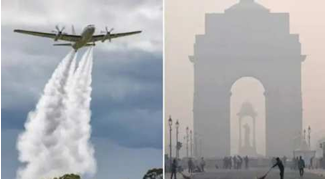
Delhi has conducted its first cloud-seeding trial, using aircraft to disperse silver iodide and sodium chloride over areas such as Burari and Karol Bagh. The initiative, led by the Delhi government in collaboration with IIT Kanpur, seeks to trigger artificial rainfall to wash out particulate pollution. This trial reflects a significant shift in Delhi’s environmental strategy; from reactive pollution control to proactive, technology-driven interventions. While cloud seeding has been used in other parts of the world, its application here underscores how water industry thinking must increasingly overlap with meteorology and…
Read MorePioneering Report Sets the Course for Nature-positive Engineering in Coastal and Marine Environments
A global engineering coalition has issued an urgent call to action to solve the climate crisis through ecology-inclusive engineering frameworks. The Foresight of Nature-Positive Engineering, a new report from Lloyd’s Register Foundation in partnership with the International Coalition for Sustainable Infrastructure (ICSI), sets out the blueprint for nature-positive engineering (NPE) in ports, offshore renewable energy, and coastal protection. Biodiversity is declining faster than at any time in human history, with extinction rates 100 to 1,000 times higher than the past ten million years. While crucial to development, the built environment…
Read MoreSafeguarding Water Quality: The Technologies Protecting Our Freshwater Future
As global demand for freshwater intensifies, the conversation must evolve beyond quantity to address an equally urgent crisis: water quality. More than half of the world’s food production could be jeopardised by freshwater shortages within the next quarter-century. But contamination may prove just as perilous. The UK’s Environment Agency reported 3.6 million hours of raw sewage discharge into rivers in 2024 alone. Poor water quality accelerates ecosystem decline, imperilling biodiversity, public health, and food security. Emerging technologies for monitoring water quality Traditionally, water quality assessment has relied on periodic sampling…
Read MoreUk Introduces Landmark Legislation to Protect World’s Ocean
The UK government is to introduce a landmark bill to protect two-thirds of the world’s ocean, a key source of food and oxygen for people in the UK and globally. In 2023, the UK signed the Biodiversity Beyond National Jurisdiction (BBNJ) Agreement—the High Seas Treaty—among the first countries to do so after playing a leading role in shaping it over more than a decade of negotiations. The bill, announced on 10 September 2025, turns that commitment into action. For the first time, the BBNJ Agreement will create a legal mechanism…
Read MoreA HIDDEN OCEAN OF FRESHWATER BENEATH THE ATLANTIC
In a discovery that could reshape our understanding of global water resources, scientists have confirmed the existence of a massive freshwater aquifer beneath the Atlantic Ocean, stretching from New Jersey to Maine. The find was made this summer during Expedition 501, an international mission drilling o Cape Cod. The story dates back to 1976, when researchers searching for oil and gas first noticed traces of fresh water seeping out of seabedcores. For decades, the phenomenon remained a mystery. Now, nearly 50 years later, scientists have returned with advanced technology —…
Read More