
A landmark report on global climate litigation has identified water as an increasingly contested terrain in courtrooms worldwide. The Global Trends in Climate Change Litigation: 2026 Snapshot, published by the Grantham Research Institute & Sabin Center for Climate Change Law, records more than 3,600 climate cases filed across 62 countries since 1986, with 249 new cases in 2025 alone.
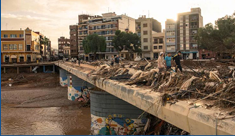
Among striking new developments are insurance subrogation cases following the April 2022 KwaZulu-Natal floods in South Africa, which killed 544 people and damaged over 4,000 homes. Japanese insurer Tokio Marine filed a claim worth approximately US$368 million against provincial authorities and the municipality, arguing that inadequate maintenance of stormwater infrastructure amplified flood damage. The report flags climate justice dimensions as complex: municipal authorities facing liability for corporate losses are responsible for infrastructure on which vulnerable communities depend, yet those communities bore the greatest physical burden and received no compensation.
Data centres emerge as a significant new frontier in climate litigation, with water at the heart. The report cites the 2020 Municipality of Cerrillos v. Evaluation Commission case in Chile, where applicants raised concerns about a proposed Google data centre’s impact on climate-stressed urban water supply. The issue is growing, with challenges emerging in the United States, United Kingdom and Ireland over data centre water use for server cooling. A December 2025 settlement on a California data centre included commitments to use recycled water & renewable energy.
Internationally, adaptation obligations are becoming more explicit. The European Court of Human Rights confirmed in 2024 that Convention parties have obligations to put in place measures to mitigate climate change. The International Court of Justice’s July 2025 advisory opinion confirmed states have obligations to ensure adaptation measures, including regulation of private actors. A Dutch court found the government had violated residents’ rights by failing to ensure adequate adaptation measures for Bonaire, ordering adoption of a climate adaptation plan by 2030.
For water sector actors, findings carry clear implications. Operators of water and wastewater infrastructure, stormwater networks and desalination facilities may face failure-to-adapt claims as international adaptation standards harden. South African cases signal that inadequate maintenance of climate-critical water infrastructure attracts substantial legal liability. Climate litigation is now treated as financially material by regulators, suggesting water-related litigation risk deserves closer attention in asset management and disclosure frameworks.