
The Union Budget 2026 comes at a time when India’s water challenges are no longer seasonal or regional—they are structural. With climate variability intensifying, urban demand rising, and groundwater levels declining, the conversation around water must move beyond supply creation to long-term resilience and accountability.
One of the encouraging aspects of this year’s budget is the continued emphasis on water security, sustainability, and infrastructure strengthening. However, the real impact of these allocations will depend on how effectively water is measured, monitored, and managed at the point of consumption—especially in urban and semi-urban India.
Historically, India’s water planning has focused heavily on sourcing and distribution. While these are critical, the absence of granular consumption data has limited our ability to optimize usage, reduce losses, and influence user behaviour. Without knowing how much water is consumed, where it is consumed, and how efficiently it is used, even the best-funded water programs risk falling short of their intended outcomes.
This is where the role of metering and digital water management becomes central. Smart water metering enables real-time visibility into consumption, supports accurate water audits, and helps identify leakages and inefficiencies early. More importantly, it introduces transparency and fairness—ensuring that water is billed and valued based on actual usage rather than assumptions or flat models.
The Union Budget 2026 presents an opportunity to accelerate this shift from water allocation to water accountability. As cities expand and residential communities grow denser, embedding metering and data-driven decision-making into urban water frameworks can significantly improve efficiency while driving behavioural change among users.
Water sustainability cannot be achieved through infrastructure alone. It requires informed users, accountable systems, and technology that enables both. When people see what they consume and understand its impact, conservation becomes a shared responsibility rather than an enforced rule.
As India charts its path toward long-term water security, the success of budgetary initiatives will ultimately be measured not by funds allocated, but by outcomes delivered—reduced wastage, improved efficiency, and a collective commitment to using water responsibly.
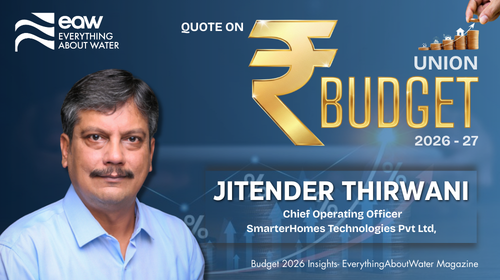
Jitender Thirwani is the Chief Operating Officer at SmarterHomes Technologies Pvt Ltd, leading the charge in transforming water management through IoT-driven innovation. With over 20+ years of experience in Business Development, Channel Sales, and Project Management, he has played a pivotal role in advancing smart water metering solutions.