
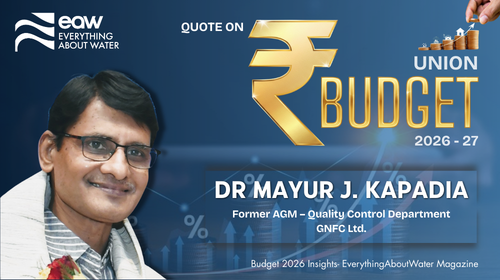
Dr Mayur J. Kapadia
Former AGM, Quality Control Dept, GNFC Ltd, Bharuch, Gujarat TC Member & Resource Person, Bureau of Indian Standards Trainer & Technical Writer ‘Elsevier’ Author.
Union Budget 2026–27 is the first budget prepared at the newly established Kartavya Bhavan. Structured around 3 core Kartavyas, it is a systems-level design document for the country’s next growth phase. While presenting it on 1st Feb, 2026, the FM defined 3 Kartavyas as (i) accelerating and sustaining economic growth, (ii) fulfilling aspirations through capacity building, and (iii) ensuring inclusive development with the principle of Sabka Sath, Sabka Vikas. From a technical lens, this framework mirrors a familiar systems approach : (i) define objectives, (ii) strengthen core infrastructure, and optimize execution.
Under the first Kartavya, the government placed strong emphasis on manufacturing, strategic industries, infrastructure, and MSME growth. Recognizing MSMEs as engines of job creation and innovation, the budget highlights their role as testing grounds for new technologies, materials, and process innovations. In the water sector, MSMEs occupy a dominant position – whether in decentralized wastewater treatment, water equipment supply, or broader water management activities. The budget’s enhanced fund allocation, improved credit access, and policy support mechanisms are expected to ease long-standing bottlenecks such as liquidity constraints and delayed payments. This support will empower MSMEs engaged in water treatment, recycling systems, smart metering, pumps, sensors, and automation, enabling indigenous design, applied engineering, and field-level innovation rather than reliance on imported solutions.
For non-finance professionals, the budget reads as an effort to create an ecosystem where technology, sustainability, and enterprise co-evolve. Its intent resonates with the engineering mindset: Build strong foundations, Enable problem-solvers, and Scale solutions that deliver impact. Of course, the execution will ultimately determine outcomes of this budget, but the design philosophy aligns well with how technologists approach complex challenges.
Overall, Union Budget 2026–27 positions itself as a national project plan. Outcomes, not announcements, are set as the key performance indicators. By embedding growth, capacity building, and inclusivity into its core design, the budget signals a shift toward systemic transformation – where fiscal policy becomes a tool for nation-building through innovation and resilience.