
Mohammed Naser Azeez, MD, Aquality Intelligent Solutions
Clean and safe drinking water is fundamental to the health, development, and academic success of school students. Children are particularly vulnerable to waterborne diseases due to their developing immune systems, and contaminated water can lead to serious illnesses, resulting in frequent absences that disrupt learning and academic progress. Beyond preventing disease, adequate hydration with safe water is essential for cognitive function, even mild dehydration can impair concentration, memory, short-term recall, and overall academic performance.
When students have confidence in their school’s water quality, they drink more frequently throughout the day, maintaining the hydration levels necessary for physical activity, temperature regulation, and mental alertness. Furthermore, providing safe drinking water in schools demonstrates an institution’s commitment to student welfare, builds trust with parents, and creates an environment where children can focus on learning rather than worrying about health risks. For many students, especially those from economically weaker communities, school may be the primary source of safe drinking water throughout the day, making institutional water treatment not just a health measure but an equity issue that ensures all children have equal access to this basic necessity for growth, development, and educational achievement.
Executive Summary
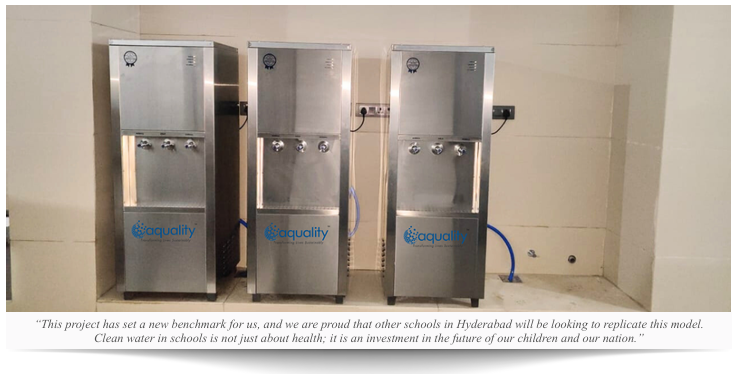
Aquality Intelligent Solutions successfully designed, supplied, and commissioned a comprehensive multi-stage water treatment system comprising 14 independent units at St. Michaels School (SMS), Alwal, Hyderabad. Each unit has a treatment capacity of 125 litres per hour and is equipped with a storage tank and ambient and cold water dispensing. It uses sediment filtration, activated carbon, and ultraviolet (UV) disinfection to provide safe drinking water to over 2,700 students, faculty, and staff. This decentralized approach to water treatment ensures accessibility, reliability, and optimal water quality throughout the school’s campus, addressing the critical need for safe drinking water in educational institutions where children’s health and well-being are supreme.
Project Background
St. Michaels School in Alwal, Hyderabad, is a prominent educational institution serving a diverse student population of over 2,700 children across primary, middle, and secondary levels. Like many schools in urban India, SMS faced significant challenges related to water quality & accessibility. The school’s existing water supply, sourced from municipal connections and borewells had variable quality with concerns including suspended particles and sediment from aging distribution infrastructure, chlorine taste and odour, potential bacterial contamination during storage and distribution, seasonal variations in water quality particularly during monsoon periods, and inconsistent taste affecting student water consumption.
With growing awareness among parents about waterborne diseases and the school administration’s commitment to student health, there was an urgent need for a reliable, comprehensive water treatment solution. The challenge was not merely installing a treatment system but ensuring safe water access across a sprawling campus with multiple buildings, different age groups with varying needs, and peak demand periods during break times.
Project Scope and Objectives
Aquality Intelligent Solutions was engaged to design and implement a complete water treatment solution tailored to the school’s specific requirements. The project scope encompassed comprehensive water quality assessment including testing of multiple water sources on campus, analysis of seasonal quality variations, evaluation of storage tank conditions, and assessment of distribution network integrity.
Based on this assessment, the team designed a distributed treatment system featuring 14 independent units strategically positioned across campus buildings. Each unit was specified at 125 LPH capacity to match localized demand patterns. The treatment technology selected was a three-stage process combining sediment filtration for removal of suspended particles, rust, and debris, activated carbon filtration for elimination of chlorine, organic compounds, odour, and taste issues, and UV disinfection for destruction of bacteria, viruses, and other microorganisms without chemical addition.
The implementation phase included related works for unit placement and plumbing modifications, electrical connections with proper grounding and safety features, installation and commissioning of all 14 units, water quality testing pre and post-treatment, staff training on operation and basic maintenance, and development of preventive maintenance schedules.
Technical Specifications and System Design
The multi-unit configuration was strategically chosen over a single centralized plant to provide several advantages specific to the school environment. Each 125 LPH unit incorporates a robust sediment filter housing with 5-micron polypropylene cartridges designed to capture particles, sediment, sand, silt, and rust. This pre-filtration stage protects downstream components and extends their operational life.
The activated carbon stage utilizes high-quality granular activated carbon (GAC) with large surface area for maximum adsorption capacity. This stage effectively removes residual chlorine that can affect taste and odour, organic contaminants including pesticides and industrial pollutants, colour and turbidity issues, and volatile organic compounds (VOCs). The carbon beds are designed for easy regeneration or replacement based on water quality monitoring.
The UV disinfection system features medium-pressure UV lamps with germicidal wavelength output at 254 nanometers, providing 99.99% destruction of bacteria including E. coli, Salmonella, and Shigella, viruses including rotavirus and norovirus, parasites like Giardia and Cryptosporidium, and other pathogenic microorganisms. The UV chambers include quartz sleeves for lamp protection, flow regulators to ensure adequate contact time, lamp life indicators for timely replacement, and safety interlocks preventing operation when lamp is not functional.
The 14-unit distributed design allows for strategic placement near high demand areas ensuring students never have to walk too long for safe drinking water, encouraging adequate hydration throughout the day.
Installation Challenges and Solutions
Implementing a comprehensive water treatment system in an operational school environment presented unique challenges that required innovative solutions and careful planning. Working within an active school setting without disrupting academic activities demanded a phased installation approach. Aquality Intelligent Solutions coordinated work schedules during weekends, holidays, and after-school hours, completed work during vacations, and maintained temporary water supply during installation periods.
The school’s existing infrastructure, with buildings of different ages & varying plumbing configurations, required adaptable solutions. The team conducted detailed surveys of plumbing, designed custom mounting solutions for different wall types and spaces, incorporated flexible piping connections to accommodate variations & ensured aesthetic installation that blended with school environment.
Electrical power availability & quality checked properly & careful power planning was carried out for added safety. Solutions included dedicated electrical circuits for each unit with proper protection, installation of voltage stabilizers where power fluctuations were observed, proper grounding systems for UV disinfection safety & backup power considerations for critical areas.
Ensuring child safety with accessible yet secure installations required thoughtful design. Units were mounted at appropriate heights for different age groups, protective covers installed for electrical components, child-safe dispensing taps with anti-scald features implemented and temperature monitoring to ensure comfortable drinking water.
Managing water quality variability from different sources & seasons demanded adaptive system design. Pre-treatment stages were sized for worst case water quality scenarios, UV lamp intensity was selected with safety margins for varying water clarity, monitoring protocols were established for different seasons & regular testing schedules were implemented to verify treatment effectiveness.
Project Outcomes and Performance Metrics
Since commissioning, the water treatment system has consistently delivered exceptional results. The combined treatment capacity of 1,750 LPH (14 units × 125 LPH) translates to approximately 14,000 litres during the typical 8 hour school day, or over 5 million litres annually. This adequately serves the 2,700+ student population with an average per-student availability exceeding 5 litres daily, well above recommended consumption for children.
System reliability has been exceptional with individual unit uptime exceeding 97%, a distributed design ensuring 100% campus coverage with preventive maintenance schedules avoiding unexpected failures and rapid component replacement minimizing downtime when issues occur.
Benefits and Impact
The health and safety benefits have been immediately apparent. The school has reported a significant reduction in waterborne illness complaints and absenteeism related to stomach ailments. Parents have expressed increased confidence in school facilities, and the administration has fulfilled its duty of care responsibility for student health. Universal access to safe drinking water has been achieved across campus with better water quality.
Educational value extends beyond health benefits. The water treatment system serves as a practical teaching tool for science classes studying water chemistry, filtration processes, and microbiology. Environmental education programs incorporate lessons about water conservation and treatment. Students develop awareness about water quality issues and solutions, and the school demonstrates institutional commitment to health and sustainability.
The social impact extends to the broader school community. Improved water access supports better student hydration and concentration, reduced health risks enable better attendance and academic performance, equitable water quality across all campus areas promotes inclusivity, and parents receive assurance about health and safety measures. The school has become a model for other educational institutions in Hyderabad seeking comprehensive water treatment solutions.
Maintenance and Sustainability
Aquality Intelligent Solutions established a comprehensive maintenance framework including sediment filter replacement based on visual inspection and monitoring, bi-annual activated carbon replacement or regeneration depending on usage patterns, annual UV lamp replacement regardless of operational status, monthly water quality testing at multiple points across campus, and annual system audit and performance optimization.
The school’s maintenance staff received thorough training and basic troubleshooting procedures, cartridge replacement procedures with hands-on practice, water quality testing using simple field kits, and escalation protocols for technical issues. This capacity building ensures long-term sustainability beyond the initial installation warranty period.
Conclusion
The installation of UV water treatment units at St. Michaels School represents a comprehensive approach to ensuring safe drinking water in educational environments. Aquality Intelligent Solutions’ distributed system design, tailored to the specific needs of a large school campus, has successfully addressed water quality challenges while ensuring accessibility, reliability, and ease of maintenance.
This project demonstrates that protecting children’s health through safe water access requires not just technology but thoughtful system design that considers the unique operational context of educational institutions. The success at St. Michaels School provides a replicable model for schools across India facing similar water quality challenges, showing that comprehensive water treatment solutions are both technically feasible and economically viable for educational institutions committed to student health and well being.