
Professor Joan Bray Rose recognised for pioneering Quantitative Microbial Risk Assessment (QMRA) as a global approach for assessing pathogen risks in water
QMRA adopted into global drinking water standards and enabled safe water reuse, benefitting millions worldwide
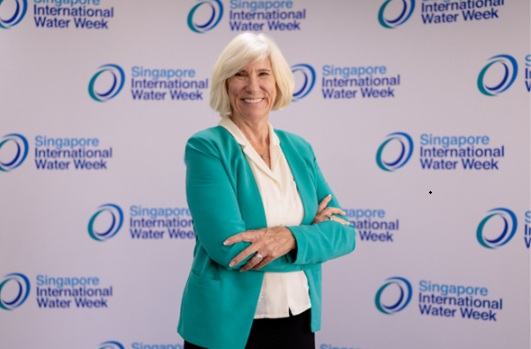
Singapore, 16 April 2026 – Professor Joan Bray Rose has been awarded the Lee Kuan Yew Water Prize 2026 for her work as a key pioneer in the development and global adoption of Quantitative Microbial Risk Assessment (QMRA), a science-based approach to safeguard the quality of drinking water, as well as water reuse systems. Her work has transformed the science of microbial risk management and guided policies that protect public health and ensure safe water for communities worldwide. Her expertise in the domain of water quality and health has also played a key role in strengthening Singapore’s used water management, and the introduction of NEWater, Singapore’s third National Tap.
2. Commenting on her accolade, Professor Rose, 11th recipient of the Lee Kuan Yew Water Prize said, “I am deeply honoured to receive this esteemed award. This recognition reflects our collective progress in advancing microbial risk science and its role in protecting public health today. Safe water is one of the world’s most fundamental yet unevenly distributed resource critical to sustaining human life. As microbial risks continue to evolve, strengthening the robustness of our water systems remains an ongoing endeavour to ensure they remain dependable and resilient; safeguarding both water quality and people’s lives.” She is currently the Homer Nowlin Chair in Water Research, Director of the Water Alliance at Michigan State University.
Uncovering invisible risks to revolutionise water safety
3. In the late 1980s and 1990s, Professor Rose led a team to investigate a series of waterborne disease outbreaks across the United States. Among the most severe was the 1993 Cryptosporidiosis outbreak in Milwaukee, Wisconsin, where an estimated 403,000 residents fell ill and at least 69 deaths were recorded[1]. She was the first to demonstrate the widespread occurrence of Cryptosporidium as a zoonotic pathogen[2] in the United States, and its transmission to humans through inadequately filtered and disinfected drinking water supplies. By establishing Cryptosporidium as the causative agent of these outbreaks, she highlighted the vulnerability of drinking water systems to microbial contamination – a challenge with global public health implications. Her findings also revealed a critical gap: pathogens could evade conventional water treatment, existing monitoring systems detected microbes without quantifying risk, and public health responses were largely reactive rather than predictive.
4. Professor Rose then pioneered QMRA in the 1990s and early 2000s to address these critical gaps undermining water safety and public health. QMRA introduced a systematic, science-based approach to assess and manage microbial risks in drinking and other forms of water, including reuse water. By enabling scientists to quantify infection risks and illness probabilities based on pathogen concentrations, exposure pathways and consumption patterns, QMRA shifted water management from reactive “detect and correct” approaches to proactive “predict and prevent” strategies. This revolutionised water safety, boosting the quality of water systems to reliably meet health standards.
Global impact on water microbiology and water quality
5. QMRA is now widely adopted in drinking water regulations worldwide including the United States Environmental Protection Agency’s Safe Drinking Water Standards and the World Health Organisation’s Third Edition of the Drinking Water Quality Guidelines in 2004. Her work has enabled water utilities and regulators to define treatment requirements based on tolerable health risks for any given water source.
6. Professor Rose extended the application of QMRA beyond drinking water to assess microbial risks in treated wastewater and water reuse systems. This development greatly strengthened global confidence in leveraging recycled water as a viable and sustainable supply source, and Professor Rose has since strongly advocated for the adoption of water reuse to address global water scarcity. She also advised the Orange County Water District’s Independent Advisory Panel and the California State Water Resources Control Board’s Expert Panel on water reuse. Her guidance contributed to California’s Indirect and Direct Potable Reuse regulations, now models for water reuse standards worldwide, including in Australia, Spain, and the United States.
7. For over two decades, Professor Rose worked closely with PUB, Singapore’s National Water Agency, to strengthen water quality and safety. She was instrumental in the advancement of NEWater which was introduced in 2003, serving on the NEWater Expert Panel from 1998 to 2002. In her role, Professor Rose shared her expertise, provided guidance on best practices for water quality monitoring, and reviewed findings from health studies which demonstrated the long-term safety of NEWater. From 2003 to 2019, she also chaired PUB’s External Audit Panel, supporting the safe and robust implementation of water reuse in Singapore. In recognition of her significant contributions, she was conferred the Honorary Citizen Award by the Government of Singapore in 2015. Tapping on the QMRA approach, PUB has since strengthened the capabilities to use water quality surveillance data to guide treatment processes and ensure compliance with local and international drinking water standards and guidelines. (Refer to Annex on how QMRA is applied in Singapore.)
8. Beyond research, she has advanced global knowledge and capacity in microbial risk assessment through training and collaborative initiatives such as launching the QMRA Summer Institute[3] and QMRAwiki[4]. She has also strengthened preparedness for waterborne disease outbreaks worldwide by spearheading major international initiatives such as the Global Water Pathogen Project[5] and Wastewater Sphere[6].
Recognising a steadfast champion of global public health
9. Professor Rose, who recently turned 72, has dedicated her professional life to improving water quality and safeguarding public health outcomes. She is widely regarded as one of the world’s leading authorities in water microbiology and received the 2024 International Water Association Global Water Award for her contributions. Today, she continues to lead research on emerging microbial health risks, driven by a deep and enduring commitment to improving lives worldwide. Her work remains critical as cities strengthen their water resilience against evolving public health and climate challenges.
10. Professor Rose will receive the Lee Kuan Yew Water Prize – an award certificate, a gold medallion, and S$300,000, presented in partnership with Temasek Foundation – at an award ceremony on 16 June 2026, held during the official opening of the Singapore International Water Week (SIWW) 2026. She will also deliver a keynote lecture the same day. SIWW2026 is expected to gather 2,500 leaders, experts and practitioners from governments, cities, utilities, and industry, and over 25,000 trade visitors.