
Amit Kapur, Chairman & Managing Director, NICO Nanobubble India Pvt. Ltd. & IOTA WATER
Introduction
Cooling towers are a critical part of many industrial and commercial facilities, including power plants, refineries, petrochemical units, steel plants, data centres, pharmaceutical facilities and large HVAC systems. Their primary function is to remove excess heat from process water and reject it to the atmosphere.
In practice, however, maintaining a cooling tower is far more complex. Continuous evaporation concentrates dissolved salts in the circulating water. Dust, suspended solids and airborne contaminants can enter the system, while warm water creates favorable conditions for bacterial growth, algae and biofilm formation. Over time, these challenges can lead to scaling, corrosion and fouling across the cooling tower and the wider cooling water circuit, including pipelines, heat exchangers, condenser surfaces and associated equipment. The resulting deposits can progressively reduce heat transfer efficiency, increase hydraulic resistance and affect overall system performance.
Most cooling-water systems are therefore operated using a combination of chemical treatment, filtration, blowdown and periodic cleaning. These methods are proven and remain essential in many installations, but they can also increase chemical consumption, water usage and operating costs. Nanobubble technology offers an additional treatment approach that can be integrated into an existing cooling-water programme to improve gas transfer, support oxidation and biological control, and enhance overall water-management performance across the cooling-water circuit.
Why Cooling-Water Quality Matters
The condition of circulating cooling water directly affects the thermal and mechanical performance of the entire cooling system. Scale deposits on heat exchangers and condenser surfaces increase thermal resistance and reduce heat-transfer efficiency. Biofilm can have a similar insulating effect while also contributing to microbiologically influenced corrosion. Suspended solids, biological deposits and scale can accumulate in cooling-tower basins, fills, pipelines and heat-transfer equipment, leading to further fouling and operational inefficiencies.
Within cooling-water pipelines, deposits can progressively reduce the effective flow area and increase pressure losses. More importantly, deposits and biofilm can create localized conditions that promote further biological growth and corrosion. These effects can extend well beyond the cooling tower itself, affecting circulation, heat exchangers, pumps and other downstream equipment.
Conventional Cooling-Water Treatment
Most cooling-water systems rely on a combination of chemical and physical treatment methods. Oxidizing biocides such as chlorine or bromine are commonly used for microbial control, while non-oxidizing biocides may be applied periodically to control resistant microorganisms and established biofilm. Scale inhibitors, dispersants and corrosion inhibitors are selected according to make-up-water chemistry and operating conditions.
Side-stream filtration is commonly used to remove suspended solids, while softening or membrane-based treatment may be applied where the make-up water contains high hardness or other problematic dissolved constituents. Periodic cleaning also remains necessary in many installations, with cooling-tower basins, fills, pipelines and heat exchangers requiring mechanical or chemical cleaning when fouling becomes excessive.
These methods are well established and continue to play an important role in cooling-water management. However, their effectiveness depends heavily on water chemistry, appropriate chemical selection, accurate dosing, continuous monitoring and effective operator control.
The Role of Nanobubbles in Cooling Towers and Cooling-Water Piping
Nanobubbles are extremely small gas bubbles, typically below 200 nm in diameter. Their behavior in water differs significantly from that of conventional aeration bubbles. Larger bubbles tend to rise rapidly and escape from the water surface, while nanobubbles exhibit very low buoyancy and can remain dispersed in water for significantly longer periods.
Their extremely small size also provides a high gas liquid interfacial area, supporting improved interaction between the gas and surrounding water. Depending on the treatment objective, nanobubbles can be generated using air, oxygen or ozone.
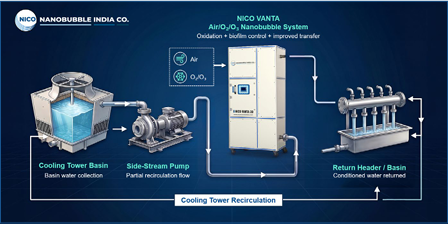
In a side-stream configuration, a portion of the circulating cooling water can be continuously diverted through the nanobubble system and then returned to the main cooling-water loop. This enables the treated water to circulate throughout the system, including cooling tower basins, distribution piping, heat exchangers and return lines, without requiring major modifications to the existing cooling-water infrastructure.
The objective is not simply to treat the water inside the cooling tower. By integrating nanobubble generation into the circulation loop, the technology can support water-quality management across the broader system where biological growth, organic fouling and other water-quality challenges may occur.
Why Ozonated Nanobubbles Are Important
Ozone is already used in selected cooling-water systems because of its strong oxidation and disinfection capabilities. One of the practical challenges with conventional ozone injection, however, is efficient gas transfer. When ozone is introduced as relatively large bubbles, a portion of the gas may escape before dissolving and reacting in the water. This can reduce ozone utilization and increase the requirements for off gas handling.
Nanobubble technology can improve ozone–water contact by generating ultra-fine bubbles with a substantially larger gas–liquid interfacial area. This can support ozone dissolution and utilization within the circulating-water system. In cooling-tower applications, ozonated nanobubbles can support microbial control, biofilm management and oxidation of organic matter while improving gas–water contact.
This is particularly relevant in systems where biological deposits develop not only in the cooling-tower basin and fills but also within pipelines, heat exchangers and other wet surfaces throughout the circulation loop.
By improving gas transfer and gas–water contact, nanobubble technology provides an additional tool for addressing biological and organic fouling challenges within cooling-water systems.
NICO’s Quantified Benefits
With properly designed and optimized O€/O€ nanobubble treatment, suitable cooling-tower applications may achieve gas-transfer efficiencies of more than 80 85%, together with a potential 20–50% reduction in oxidizing-biocide demand. Reductions of approximately 20–40% in biofilm and organic-fouling indicators may also be achievable, depending on baseline conditions and the overall treatment programme.
Cleaner circulating-water conditions can potentially extend cleaning intervals by approximately 20–40% while helping maintain heat-transfer performance by limiting biological and organic deposit formation across cooling towers, pipelines and heat-transfer equipment.
Actual results will depend on factors including water chemistry, biological loading, system geometry, existing treatment practices, system design, operating cycles and the integration of nanobubble technology with the overall cooling-water programme. These values should therefore be validated through site-specific trials and performance monitoring.
Cost-Saving Potential
The economic benefits of nanobubble-based cooling water treatment can arise from lower chemical consumption, reduced cleaning requirements, improved operational efficiency and optimized water management. Suitable applications may achieve a 20–50% reduction in oxidizing-biocide consumption and a 15–30% reduction in cleaning and maintenance costs, in addition to reduced energy losses associated with fouling and poor heat transfer.
Where make-up-water chemistry and operating conditions permit, increasing the cycles of concentration from three to five can theoretically reduce blowdown demand by approximately 50%. Depending on the overall water balance, this may contribute to a 10–20% reduction in make-up-water demand.
Reducing biological and organic fouling throughout the cooling-water circuit can also help maintain hydraulic performance and heat-transfer efficiency. In applications where fouling contributes significantly to pressure losses or heat-transfer deterioration, this can provide an additional operational benefit beyond direct chemical savings.
Overall operating-cost savings of approximately 10 – 25% may be a reasonable project target for suitable applications, subject to baseline water chemistry, existing treatment practices, cooling-tower operation and the operating cost of the nanobubble system. A site-specific technical and economic assessment is essential to establish the actual potential for each installation.
Conclusion
Cooling towers should not be viewed in isolation. They are part of a larger cooling-water circuit in which basins, distribution systems, pipelines, heat exchangers, condenser surfaces and return lines collectively determine the reliability and efficiency of heat rejection.
As industries face tighter water, energy and environmental constraints, conventional chemical treatment remains an important part of cooling water management, but there is growing scope for complementary technologies that can reduce the overall treatment burden and improve system efficiency.
Nanobubble technology provides a promising retrofit approach for improving gas transfer, supporting oxidation and biological control, and addressing fouling related challenges across the cooling-water circuit. With appropriate system design and site-specific optimization, it can be integrated into existing cooling water programmes with relatively limited modification to existing infrastructure.