
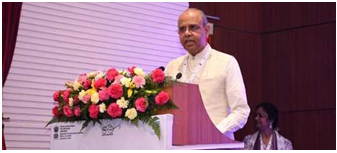
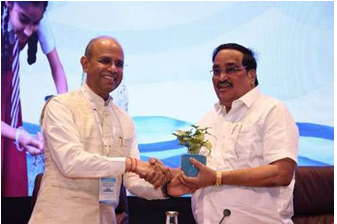
The Department of Drinking Water and Sanitation organised a one-day workshop of the Rural WASH Partners’ Forum on “Communication and PRA Tools to Promote Community Engagement (Jan Bhagidari)” on 12th November 2025 at SCOPE Complex, New Delhi.
The workshop began with the unveiling of four key initiatives by Union Minister of Jal Shakti, Shri C.R. Patil: a Decision Support System for Source Sustainability, the JJM Panchayat Dashboard, the Community Radio Programme “Swachh Sujal Gaon Ki Kahani: Radio Ki Zubani”, and a handbook on Community-Managed Piped Water Systems titled “Jan Bhagidari se Har Ghar Jal”.
The Minister highlighted that over 9 crore women have been freed from water fetching drudgery, with WHO estimates suggesting rural India can save 5.5 crore person-hours daily.
Decision Support System
The DSS is a comprehensive digital planning tool integrating multiple datasets to guide decision-making for source sustainability. Currently operational in 234 districts, it integrates layers including rainfall, water level, slope, drainage, aquifers, recharge potential areas, land use, and water quality. The next phase will include springshed data, criticality assessment, and district level rainfall data.
JJM Panchayat Dashboard
The dashboard strengthens data transparency and decentralized monitoring through the e-Gram Swaraj Portal. To date, 67,273 Sarpanch and Panchayat Secretaries have logged in. The platform enables Panchayats to provide real-time information on water supply status, view pipelines and assets, update operator details, and access IEC material and water quality data.
Community Radio Programme
Swachh Sujal Gaon Ki Kahani: Radio Ki Zubani” will be aired through 100 radio stations in 13 national and 34 local dialects, featuring characters sharing transformation stories with quiz competitions and community segments.
Handbook on Community-Managed Systems
The handbook provides a guide for Gram Panchayats, VWSCs, and community leaders on commissioning and handing-over protocols. It outlines the District Technical Unit mechanism for technical support and encourages villages to organize ceremonies such as “Jal Arpan” and “Jal Bandhan” to celebrate water as a shared responsibility.
Workshop Sessions
Eight thematic breakaway sessions brought together partners and teams to co-create Participatory Rural Appraisal tools covering functionality assessment, source sustainability, commissioning protocols, preventive maintenance, enterprise models, safe water awareness, greywater celebrations.
The workshop concluded with participants urged to translate the new launches into tangible field-level outcomes, reinforcing commitment to sustaining water supply through community participation.