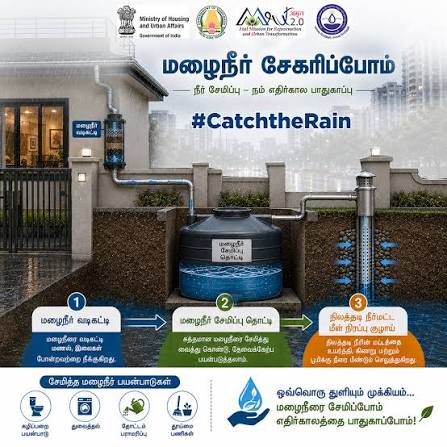

At a time when scorching heat and water scarcity trouble several parts of Chhattisgarh, a water conservation movement in Korea district is showing promising results. Known as the “5% model”, the initiative encourages villagers to dedicate 5% of their agricultural land for soak pits that help rainwater percolate into the ground, contributing to significant improvement in groundwater levels.
The model has drawn national attention. Prime Minister Narendra Modi highlighted it in his Mann Ki Baat programme in March, while Union Jal Shakti Minister C R Patil has suggested it could be adopted as a policy across the country.
Korea district, despite being located in a recharge zone, has grappled with declining groundwater levels. Last summer, District Collector Chandan Tripathi launched the “5% model”, under which villagers were trained to construct soak pits. Nearly 2,000 soak pits were dug between March and May, including more than 1,000 on agricultural farms.
The initiative gained momentum this year. Between February and May, villagers dug around 30,000 soak pits—a 15-fold increase over the previous year—largely on farms, in backyards and kitchen gardens. Ashutosh Chaturvedi, Chief Executive Officer of the Korea Zila Panchayat, noted that people saw the benefits firsthand, with complaints about borewells drying up already decreasing.
Apart from the 5% model, the district administration introduced a “30–40 model”, under which trenches are dug on barren land to arrest and store rainwater runoff. In all, 12 water conservation interventions were undertaken under MGNREGS, collectively branded Aawa Paani Jhonki, meaning “let’s catch the rain” in the Sargujia dialect.
According to data from the Central Ground Water Board, the district’s post-monsoon groundwater level improved from 6.6 metres below ground level in 2024 to 3.89 metres BGL in 2025. Two villages were identified as model centres for water conservation, where intensive interventions were carried out. Village leaders report that more than 100 villagers have adopted the 5% model, with contour trenches created and soak pits dug near borewells, though they emphasise more needs to be done.