
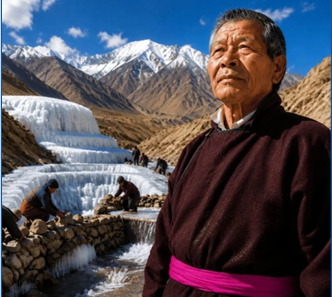
As Himalayan glaciers retreat and water scarcity threatens farming communities, engineer Chewang Norphel, popularly known as the “Ice Man of Ladakh,” pioneered artificial glaciers to help villages secure water when they need it most. His simple yet revolutionary technique proves that local innovation can offer powerful climate solutions.
For decades, Ladakh’s glaciers have been the lifeline of its people, feeding streams that irrigate crops. Rising temperatures and declining snowfall have disrupted this fragile balance, leaving farming communities struggling with severe water shortages during the crucial sowing season. Norphel’s journey began when he travelled across remote villages and observed a common concern: water flowed abundantly during winter, but natural glaciers only began melting in June, while crops required irrigation in April and May, forcing farmers to delay sowing or risk crop failure.
The inspiration came when Norphel observed water from a tap freezing beneath a shaded area during winter. This observation led him to ask whether the same principle could be applied on a larger scale. His method uses gravity, natural terrain and freezing temperatures. During winter, stream water is diverted through gently sloping channels at higher elevations. Stone embankments slow water flow, allowing it to spread across shaded ground where sub-zero temperatures gradually freeze it into thick sheets of ice. Unlike natural glaciers that take centuries to form, these artificial glaciers are recreated every winter and begin melting weeks before natural glaciers, providing timely irrigation water.
In Nang village near Leh, the artificial glacier acts as a seasonal reservoir, supplying water during the critical sowing period and helping improve agricultural productivity. A defining feature is that the innovation belongs to the community. Villagers actively participate in constructing and maintaining artificial glaciers using locally available materials, keeping costs low while ensuring long-term sustainability as communities develop independent maintenance skills.
Norphel has established artificial glaciers across several villages in Ladakh, improving water security for thousands. He was awarded the Padma Shri for his work in environmental conservation. His innovation has influenced other water conservation initiatives, including engineer Sonam Wangchuk’s Ice Stupa project, though Norphel emphasises that artificial glaciers remain simpler and more affordable. Researchers increasingly view artificial glaciers as an effective adaptation strategy for mountain regions facing glacier retreat.
Artificial glaciers demonstrate how indigenous knowledge, observation and practical engineering can solve local environmental challenges. The model highlights the importance of community participation in conservation, showing that sustainable solutions are strongest when local people become active partners. While no single solution can stop glacier retreat, empowering local people with practical, affordable technologies may prove essential in building resilience as climate change continues to reshape fragile Himalayan ecosystems.