
Meta Description: For utilities, regulators, and corporate energy managers, smart meters unlock faster billing, distributed energy resource (DER) integration, and targeted grid investments. Let’s unfold the fundamental factors behind the market’s billion-dollar revenue stature and understand how it’s entering across a myriad of industries.
Smart Meters Market: The Future of Global Energy Infrastructure
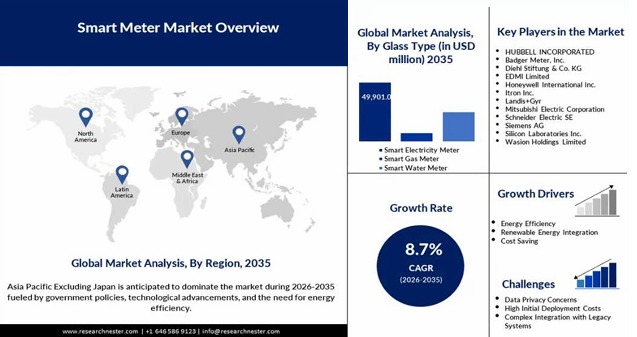
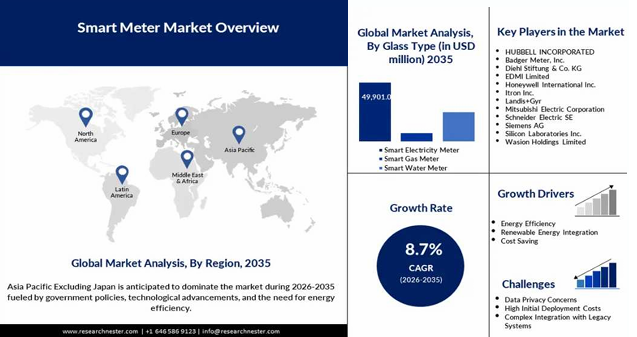
The IEA recorded that the total energy-related CO2 emissions increased by around 0.8% in 2024, hitting an all time high of almost 37.8 Gt in 2021. Thus, governments across the world are making their best efforts to achieve zero energy-related CO2 emissions, and smart meters are the way to achieve it sooner. The global smart meter industry is going to rise higher in the future, backed by a powerful convergence of climate goals, technological advancement, and economic necessity. Let’s unfold the fundamental factors behind the market’s billion-dollar revenue stature and understand how it’s entering across a myriad of industries.
Smart Meters: Why the World Is Inclining More Towards Them?
Nothing is more important than deploying smart meters in modern energy infrastructure. It is a tangible, scalable technology that delivers instant value today while building the ground for the grid of tomorrow. Governments globally are investing and allocating heavy budgets to deploy smart meters and modernize grids. A great instance of the government’s initiative can be noticed when the US Department of Energy (DOE) invested more than USD 1.5 billion in four transmission projects to improve its electricity grids.
1. Massive Deployed Base and Clear Growth Runway
By the end of 2023, more than 1 billion smart meters, including electricity, water, and gas, had been installed globally, signifying that the market is already large and still expanding into new geographies and verticals. As the installation increases, it creates a lucrative base for software and services beyond hardware sales. Not only does this large deployment decrease unit cost, streamlines logistics, and provides various ways to connect between utilities and vendors. Thus, for smart meter manufacturers, vendors, and contractors, it’s a lucrative pathway to generate constant monetization as it delivers a lifetime service scope.
2. Policy And Regulation Are Driving Rollout
Governments and regulatory bodies are noticing smart meters as the heart of achieving decarbonization, energy efficiency, and grid modernization. In the U.S., roughly 119 million AMI installations covered about 72% of electric meters in 2022, demonstrating a powerful mainstream adoption and robust government support. The European also aiming for an 80% rollout of smart meters by 2030. These public commitments limit regulatory risk and make large acquisition programs viable.
3. Distribution-Level Digitalization Increases ROI
The IEA shared that the distribution sector accounts for roughly three-quarters of investment in grid digitalization, a huge portion of which is related to the smart metering operations. As distribution networks become the epicenter for DERs and EV charging, smart meters provide a measurable ROI through limited losses and provide focused power outage management.
4. Helps In Providing Recurring Services
Smart meters produce a continuous flow of electricity and operational data. Utilities and energy providers are using this system to provide recurring services like predictive governance, demand response programs, and outage alerts. Other than operational efficiency, leveraging these recurring services creates new ways of revenue generation. These recurring service models make smart meters a consistent cash-generating asset rather than a one-time sale.
How Various Industries Are Adopting Smart Meters
The smart meters are valued far beyond just providing automated billing. They are actually used in different industries as planned devices to optimize operational efficiency through intelligence and financial control.
● Utilities and Energy Providers:
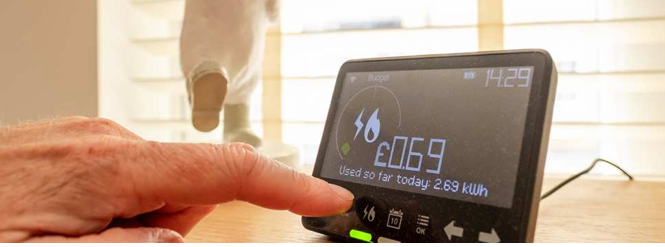
The utility sector, more particularly the electric, water, and gas sector, makes the most out of smart meters. In fact, they are the largest adopter of these systems. Smart meters provide real-time governance, automated billing, and quicker outage detection. Utilities that involve Pacific Gas & Electric and Con Edison are using smart meters to enhance grid operations and unify distributed energy resources, including solar and battery storage.
● Commercial & Industrial Enterprises:
Large-scale commercial and industrial entities are deploying smart meters to develop an energy automation system and manage energy in a better way. The data from smart meters helps to manage the highest electricity load, limit demand charges, and enhance operational effectiveness. Sectors like manufacturing, logistics, hotels, and hospitality are majorly incorporating smart meters to reduce operational costs and optimize performance.
● Renewable Energy Sector:
Renewable energy firms that involve mostly solar and wind energy sources incorporate smart meters for grid monitoring and to measure production. When the center gets real-time data on the consumption and generation of energy, it becomes easier for them to participate, anticipate, and settle in ancillary service markets. This ensures effortless renewable energy integration and also helps to comply with grid codes.
● EV Infrastructure and Water and Gas Industries:
The EV charging stations are another point where smart meters are highly used to monitor charging and vehicle-to grid operations. Thus, by supervising charging during peak hours, the operators can reduce grid stress and present pricing resilience to customers. In municipalities or in smart cities, smart meters are imperative because they provide alerts on detecting water leaks, limit non-revenue usage, and automate billing.
Across sectors, the adoption of smart meters provides sustainability compliance, better decision-making abilities, and operational efficiency.
Final Thought
Smart meters are the sensor layer of a decarbonized, resilient grid. To make energy more flexible and transparent to comply with global mandates, smart meters are imperative. It represents infrastructure with both immediate operational value and long-term platform upside.