
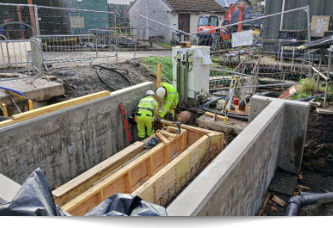
Tyndrum Wastewater Treatment Works in Stirlingshire, Scotland, has upgraded its process screening capacity to handle more than triple its original volume, increasing capacity from 3.2 litres per second to 10.6 L/s. WGM Engineering delivered the full design plus civils, construction, MEICA fit-out and commissioning for Scottish Water, completing the project in July after extensive testing.
The 1981-built plant’s age and location within a tourist-dependent village created significant challenges. The plant had to remain operational throughout construction, requiring temporary screenings and over-ground pumping. “Installation faced unforeseen hurdles due to the age of the existing infrastructure,” said WGM Engineering Project Manager Scott Ross. “A number of uncharted services were discovered at critical locations, requiring our design to be redrafted multiple times. Compliance regulations meant we couldn’t simply remove these services or go around them.”
Tyndrum sits on the West Highland Way and depends on summer tourism, making timing critical. “The project had to be completed before the summer tourist season began in July, giving us just over seven months to deliver and commission the upgrades,” Ross explained. To avoid damaging unknown services, WGM’s team used vacuum excavators rather than mechanical digging, aligning with Scottish Water’s ‘zero strike’ policy.
The retrofit approach enabled significant carbon and resource savings. “Our design team delivered a solution that increased the lifespan of existing assets, removing the need to demolish the current site and build a new treatment plant,” Ross said. “We reused construction materials to provide hardstanding areas, additional parking for local businesses and improved boundary fencing, achieving a carbon saving of 10–11 tonnes of CO₂ equivalent.” The MEICA installation required modifications to the original electrical control panel to integrate the new screens.
Scottish Water Project Manager Robin Johnson said: “Our collaboration with WGM Engineering delivered an efficient, low-carbon retrofit that kept the works online while more than doubling screening capacity. By navigating legacy services and a tight seasonal window, we strengthened resilience, improved environmental compliance and minimised disruption for the local community. This upgrade future-proofs a critical stage of the treatment process and supports Scottish Water’s commitment to sustainability and value for money.”